STAR Method Guide: 10+ Examples for Behavioral Interviews
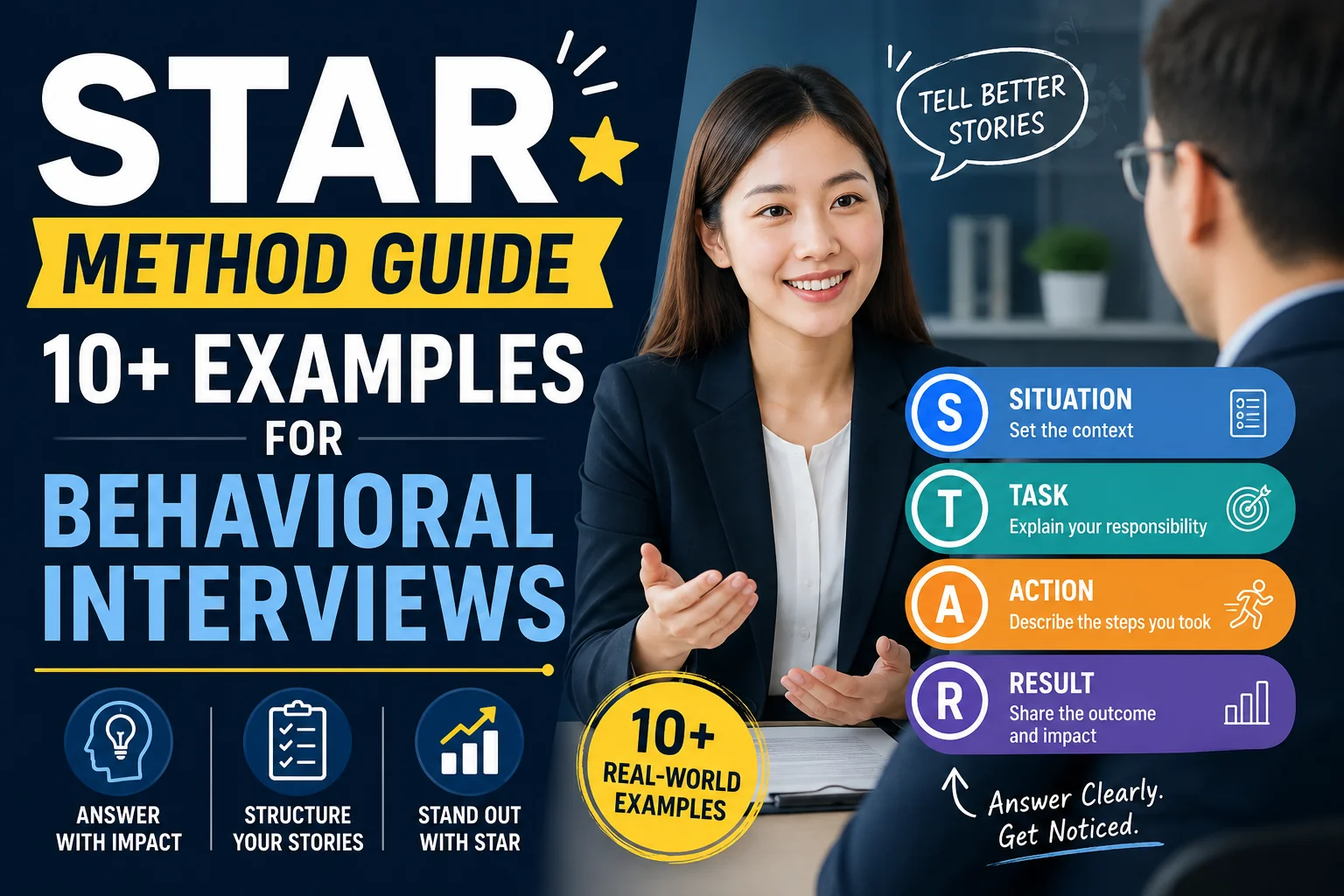
Behavioral interviews are won or lost on structure. The STAR method — Situation, Task, Action, Result — is the framework recruiters at Amazon, Google, Meta, and most Fortune 500s expect you to use. This guide breaks it down and gives you 10+ ready-to-use templates you can practice live with Maya, our AI interviewer.
What is the STAR method?
- Situation — the context. 1–2 sentences.
- Task — your specific responsibility. 1 sentence.
- Action — what you did (not the team). 2–4 sentences with concrete steps.
- Result — the measurable outcome. 1–2 sentences with a number.
Why interviewers love it
STAR forces you to be specific. Vague answers ("we improved performance") get scored as low-signal; specific ones ("I cut p95 latency from 800ms to 220ms") get scored as high-signal. Every rubric we've seen — including AceTheIV's own scoring — rewards specificity.
How to build a STAR story library
- Brainstorm 8–10 stories from the last 2 years.
- Write each in 4 bullet points (S/T/A/R).
- Tag each story with the trait it shows: leadership, conflict, ambiguity, failure, ownership.
- Practice each one out loud — first in 2 minutes, then in 60 seconds.
10+ sample STAR answers
1. Tell me about a time you led a project under tight deadlines.
- Situation:
- Our team had 3 weeks to ship a customer dashboard before a board demo.
- Task:
- As tech lead, I had to scope, assign, and ship without sacrificing quality.
- Action:
- I broke the work into 5 vertical slices, ran daily 10-minute standups, and cut two stretch features after week 1.
- Result:
- We shipped on day 19, the demo closed a $400K renewal, and we adopted the same slicing approach for the next quarter.
2. Describe a conflict with a coworker and how you handled it.
- Situation:
- A senior engineer kept pushing back on my code reviews and blocking merges.
- Task:
- I needed to unblock the team without escalating.
- Action:
- I set up a 1:1, asked what concerns drove the reviews, and we agreed on a written code-style doc.
- Result:
- Merge time dropped from 3 days to under 8 hours; we shipped the feature a week ahead.
3. Tell me about a time you failed.
- Situation:
- I shipped a pricing change without an A/B test.
- Task:
- I owned the rollout and the revenue impact.
- Action:
- When MRR dropped 6% in week 1, I rolled back in 4 hours, ran a proper experiment, and re-launched the winning variant.
- Result:
- We recovered the lost MRR within the month and added 'must A/B' to our launch checklist.
4. Describe a time you had to learn something quickly.
- Situation:
- I joined a team using a framework I'd never touched.
- Task:
- I had to ship a feature in 2 weeks.
- Action:
- I spent 2 days building a throwaway clone of a tutorial, paired with two engineers, and kept a daily 'questions' doc.
- Result:
- I shipped the feature on time and the doc became onboarding material for the next two hires.
5. Tell me about a time you went above and beyond.
- Situation:
- A customer hit a critical bug 2 hours before their own demo.
- Task:
- I was on-call and the bug was in code I didn't own.
- Action:
- I stayed on a screen-share, traced it to a config bug, and shipped a hotfix in 90 minutes.
- Result:
- Their demo went off without an issue and they expanded to a $120K annual plan the next quarter.
6. Describe a time you disagreed with your manager.
- Situation:
- My manager wanted to ship a feature without security review.
- Task:
- I believed it would expose us to a data-leak risk.
- Action:
- I wrote a one-page memo with three concrete attack scenarios and proposed a 2-day review instead.
- Result:
- We delayed the launch, found one of the issues in review, and avoided a likely incident.
7. Tell me about a time you took ownership of a problem outside your job.
- Situation:
- Our onboarding emails had a 9% bounce rate and nobody owned them.
- Task:
- I wasn't on the lifecycle team but I was losing sign-ups in my funnel.
- Action:
- I audited the templates, fixed three broken links, and switched to a verified sending domain.
- Result:
- Bounce rate dropped to under 1% and activation rose 12% in the next cohort.
8. Describe a time you persuaded someone to change their mind.
- Situation:
- Our PM wanted to build a custom analytics stack from scratch.
- Task:
- I needed to convince them to use a managed product instead.
- Action:
- I built a 1-hour prototype on the managed tool, costed both options, and walked through a 2-year TCO.
- Result:
- We shipped analytics 6 weeks earlier and saved an estimated $180K in eng time.
9. Tell me about a time you mentored someone.
- Situation:
- A new grad was struggling to break down their first big feature.
- Task:
- As their tech buddy I wanted to unblock them without doing the work for them.
- Action:
- We pair-scoped a project plan, I taught them how to write design docs, and reviewed their PRs daily for two weeks.
- Result:
- They shipped on time, presented the design at our team review, and now mentor the next cohort.
10. Describe a time you handled an ambiguous problem.
- Situation:
- Leadership asked me to 'figure out why retention is bad' with no further scope.
- Task:
- I had to define the problem before solving it.
- Action:
- I segmented users by cohort and feature use, found a 40% week-2 drop in mobile users, and proposed three experiments.
- Result:
- The winning experiment raised week-2 mobile retention from 38% to 51%.
Practice your STAR stories with Maya
Reading templates is not enough — recruiters can tell the difference between rehearsed and internalized stories. Run a free 10-minute mock interview with Maya, our AI interviewer. She'll ask behavioral questions, push back when answers get vague, and score each response on Specificity, Structure, Role-fit, Communication, and Engagement.