
50 Common Interview Questions and How to Answer Them
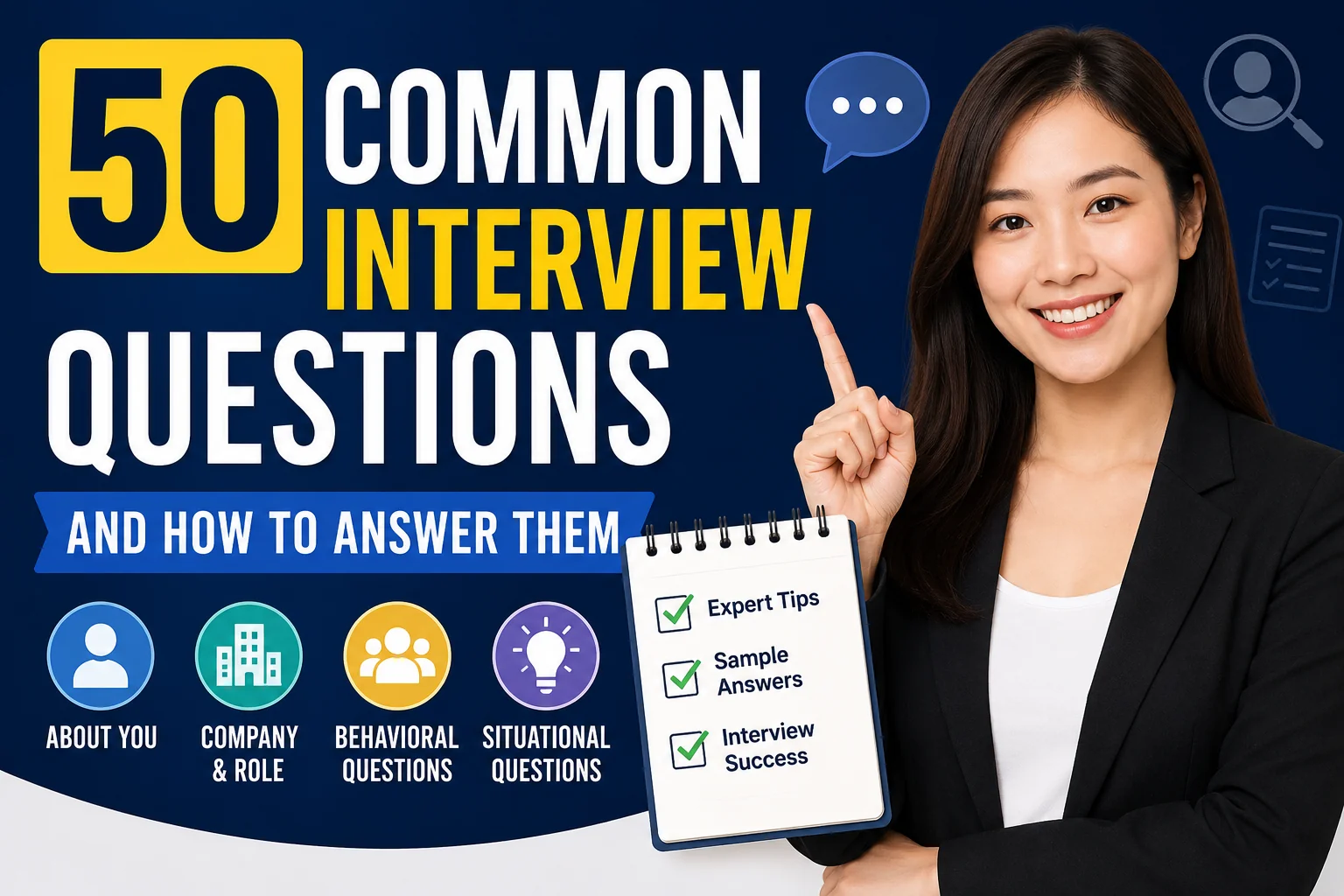
Preparing for a job interview can be stressful, especially when you don't know what questions the interviewer will ask.
The good news is that many interview questions are predictable.
While every interview is different, employers often ask questions about your background, skills, experience, strengths, weaknesses, motivation, and ability to handle different situations.
Knowing the most common interview questions can help you prepare your thoughts and feel more confident on the big day.
Here are 50 common interview questions and tips on how to answer them.
1. Questions About Yourself
1. Tell me about yourself.
How to answer:
Give a short professional introduction covering your education, relevant experience, key skills, and why you're interested in the position.
Tip: Keep your answer focused on your professional background rather than your personal life.
2. Walk me through your resume.
How to answer:
Briefly explain your education and experience in chronological order, focusing on achievements and skills relevant to the position.
Tip: Don't simply read your resume. Tell the story behind your experience.
3. What are your greatest strengths?
How to answer:
Choose two or three strengths that are relevant to the job and provide a short example.
Example:
"One of my strengths is problem-solving. During my final-year project, I faced a technical issue and worked with my team to identify and test several solutions."
4. What is your biggest weakness?
How to answer:
Choose a genuine but manageable weakness and explain what you're doing to improve it.
Avoid: Saying "I have no weaknesses" or using an obvious cliché like "I'm a perfectionist."
5. How would your friends or colleagues describe you?
How to answer:
Choose two or three positive qualities and support them with a brief example.
6. What motivates you?
How to answer:
Talk about something that genuinely motivates you, such as learning new skills, solving problems, achieving goals, or contributing to a team.
7. What makes you different from other candidates?
How to answer:
Focus on your unique combination of skills, experiences, attitude, or perspective.
Tip: Don't criticize other candidates. Focus on what you bring to the role.
8. What is your biggest achievement?
How to answer:
Choose an achievement that demonstrates skills relevant to the job. Explain the situation, what you did, and the result.
9. What are you most proud of?
How to answer:
Choose a professional, academic, or personal achievement that demonstrates your character, determination, or growth.
10. What are your career goals?
How to answer:
Explain where you want to develop professionally and how the position fits into your career journey.
2. Questions About the Company and Position
11. Why do you want to work for us?
How to answer:
Show that you've researched the company. Mention something specific about its products, culture, mission, or industry.
12. What do you know about our company?
How to answer:
Briefly explain what the company does, who it serves, and something relevant that you learned during your research.
13. Why did you apply for this position?
How to answer:
Connect your skills, interests, education, and career goals to the responsibilities of the position.
14. Why should we hire you?
How to answer:
Summarize the most relevant skills and qualities you bring and explain how they can benefit the company.
15. What interests you about this role?
How to answer:
Mention specific responsibilities or aspects of the position that genuinely interest you.
16. What do you think you can contribute to our company?
How to answer:
Focus on your relevant skills, experience, ideas, and willingness to learn.
17. Why are you leaving your current job?
How to answer:
Keep your answer positive and professional. Focus on your desire for growth, new challenges, or a better alignment with your career goals.
Avoid: Speaking negatively about your previous employer.
18. Why did you leave your previous job?
How to answer:
Be honest but professional. Explain the reason briefly and focus on what you're looking for in your next opportunity.
19. Why have you changed careers?
How to answer:
Explain what motivated the change and connect your transferable skills to the new career.
20. What are you looking for in your next job?
How to answer:
Mention factors such as opportunities to learn, meaningful responsibilities, career development, and a positive working environment.
3. Questions for Fresh Graduates and Candidates With Little Experience
21. You don't have much experience. Why should we hire you?
How to answer:
Focus on your transferable skills, education, projects, internships, willingness to learn, and ability to adapt.
22. Tell me about your university experience.
How to answer:
Highlight projects, leadership roles, teamwork, competitions, or activities that helped you develop relevant skills.
23. What did you learn from your internship?
How to answer:
Mention both technical and soft skills, and explain how the experience prepared you for the workplace.
24. Tell me about your final-year project.
How to answer:
Explain the project's purpose, your role, the challenges you faced, and the final result.
Tip: Be prepared for follow-up questions.
25. What skills did you develop during your studies?
How to answer:
Choose skills relevant to the job, such as communication, teamwork, technical knowledge, research, problem-solving, or time management.
26. How will you adapt from university to the workplace?
How to answer:
Show that you understand the workplace requires accountability, teamwork, professionalism, and continuous learning.
27. What is your biggest challenge as a fresh graduate?
How to answer:
Be honest about your lack of professional experience, but explain how you are actively working to overcome it through learning, practice, or personal projects.
28. Why should we choose you over someone with more experience?
How to answer:
Focus on your adaptability, fresh perspective, enthusiasm, relevant skills, and willingness to learn.
29. What would you do if you were given a task you had never done before?
How to answer:
Explain that you would clarify expectations, research the task, seek guidance when necessary, and learn quickly.
30. Where do you see yourself in five years?
How to answer:
Show ambition while keeping your answer realistic. Explain how you hope to develop your expertise and take on greater responsibilities.
4. Behavioral Interview Questions
For questions that begin with "Tell me about a time...", consider using the STAR method:
S — Situation: What happened?
T — Task: What was your responsibility?
A — Action: What did you do?
R — Result: What happened?
31. Tell me about a time you solved a difficult problem.
How to answer:
Choose a specific example and focus on your thought process and actions.
32. Tell me about a time you made a mistake.
How to answer:
Be honest. Explain what happened, how you handled it, and what you learned.
Tip: Show growth rather than trying to pretend you've never made mistakes.
33. Tell me about a time you failed.
How to answer:
Describe a genuine setback and focus on the lessons you learned and how you improved afterward.
34. Tell me about a time you worked under pressure.
How to answer:
Explain the situation, how you prioritized your tasks, and how you maintained your performance.
35. Tell me about a time you had to meet a tight deadline.
How to answer:
Explain how you planned your work, prioritized important tasks, and delivered the result.
36. Tell me about a time you worked in a team.
How to answer:
Describe your role, how you collaborated with others, and the outcome of the project.
37. Tell me about a conflict you had with a teammate.
How to answer:
Focus on how you communicated, listened, and worked toward a professional solution.
Avoid: Blaming or criticizing the other person.
38. Tell me about a time you showed leadership.
How to answer:
Leadership doesn't always mean being a manager. You can discuss leading a university project, organizing an event, or taking responsibility during a difficult situation.
39. Tell me about a time you received criticism.
How to answer:
Show that you were open to feedback and explain how you used it to improve.
40. Tell me about a time you had to learn something quickly.
How to answer:
Explain what you needed to learn, how you learned it, and how you applied your new knowledge.
5. Situational and Problem-Solving Questions
41. What would you do if you disagreed with your manager?
How to answer:
Explain that you would respectfully share your perspective, listen to their reasoning, and work toward the best solution for the team.
42. What would you do if you didn't know how to complete a task?
How to answer:
Explain that you would first try to understand the problem, research possible solutions, and ask for guidance when necessary.
43. How do you prioritize multiple tasks?
How to answer:
Explain how you consider urgency, importance, deadlines, and business impact.
44. What would you do if you made a serious mistake at work?
How to answer:
Say that you would take responsibility, inform the relevant person, help fix the problem, and learn how to prevent it from happening again.
45. What would you do if a teammate wasn't contributing?
How to answer:
Explain that you would first communicate with the teammate to understand the situation before escalating the issue.
46. How do you handle stress?
How to answer:
Describe practical strategies such as prioritizing tasks, planning ahead, taking short breaks, and maintaining clear communication.
47. How do you handle criticism?
How to answer:
Show that you view constructive feedback as an opportunity to improve.
48. What would you do if you disagreed with a team decision?
How to answer:
Explain that you would respectfully share your concerns, listen to the team's perspective, and support the final decision once it has been made.
6. Questions About Your Future and Availability
49. Are you willing to relocate or travel?
How to answer:
Be honest about your flexibility. If you have limitations, explain them clearly and professionally.
50. Do you have any questions for us?
How to answer:
Always prepare one or two questions.
For example:
- What would success look like in this role during the first six months?
- What does a typical day look like in this position?
- What are the biggest challenges someone in this role might face?
- What are the next steps in the hiring process?
Asking thoughtful questions shows that you're interested in the position and thinking seriously about the opportunity.
How to Prepare for These 50 Interview Questions
Don't try to memorize 50 perfect answers.
Instead, prepare a few key stories from your experience that you can adapt to different questions.
Think about examples involving:
- A difficult problem you solved
- A successful project
- A mistake you learned from
- A time you worked in a team
- A conflict you handled
- A time you showed leadership
- A challenging deadline
- A new skill you learned
Practice explaining these stories using the STAR method.
Most importantly, practice answering questions out loud.
You can practice with a friend, record yourself, or use a mock interview platform like AceTheIV to simulate a real interview experience.
Final Thoughts
Preparing for an interview isn't about memorizing the perfect answers.
It's about understanding your own experiences, knowing what the company is looking for, and being able to communicate your strengths clearly.
If you're a fresh graduate, remember that you don't need years of experience to demonstrate your potential. Your university projects, internships, part-time jobs, and personal experiences can all provide valuable examples.
The more you practice, the more comfortable you'll become.
Don't let your first interview be your first practice.
Practice your answers, improve your confidence, and prepare yourself before the real interview.
Ready to Practice?
Try a mock interview with AceTheIV and experience realistic interview practice before your next job interview.
Practice. Improve. Interview with Confidence.